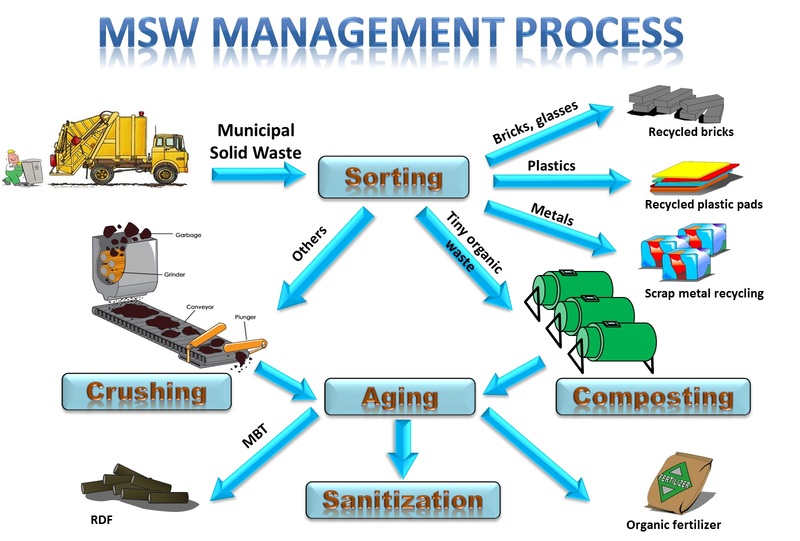
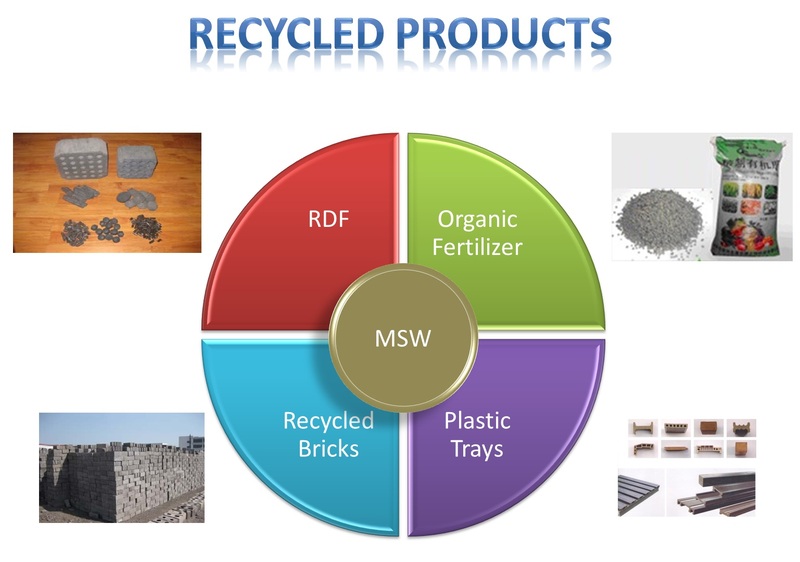
Classification of RDF
| Category | RDF-1 | RDF-2 | RDF-3 | RDF-4 | RDF-5 | RDF-6 | RDF-7 |
| Description | After removal those large size of waste, those remaining combustible solid waste are used as the fuel | By magnetic separation to remove 95 WT% of metals from MSW, the waste is crushed into coarse particles. Those remaining combustible waste which can pass through the sieve of 152.4mm, is used as the fuel | Removing 95WT% of metals, glass and inorganic matters, the waste is then crushed into immature particles. The combustible solid waste which can pass through the sieve of 50.8mm, is used as the fuel | 95WT% of metals, glass and inorganic matters are removed from MSW. The remaining waste is crushed into powder form. The size must be able to pass through the sieve of 0.889mm. Those combustible solid waste is used as the fuel | Removing metals, glass and other non-combustible matters from MSW, it is then grinded, dried and mixed with additives. Those combustible solid waste can be compressed into cylindrical, spherical, rectangular or other shapes as the fuel | MSW is processed into fluid form of fuel | MSW is processed into gaseous form of fuel |
| Remarks | MSW | Coarse RDF C-RDF | Fluff RDF F-RDF | Powder RDF P-RDF | Densified RDF D-RDF | Liquid Fuel | Gaseous Fuel |
Comparison of Mechanical Biological Treatment (MBT), Incineration and Land Filling methods
| Global Environment | Secondary Pollution | Energy Usage | Cost of Pollution Prevention | Ash Management | |
| MBT | Energy recovery is good. It can replace some parts of fossil energy. Good in CO2 reduction (emission is about25%-50% of incineration), it helps to ease the global warming effect | Little secondary pollution, it can effectively reduce the emission of dioxin | Production scale of RDF-5 can be varied. The production can be done at the site of waste collection. Those RDF-5 can be used for different applications (e.g. power plants); the fuel is stable and easy to be controlled, the efficiency of power generation can be reached to as high as 35% | Combustion of exhaust complies with the regulation of emission of dioxin. The investment in pollution prevention is less | Complete combustion, less unburned materials, low loss on ignition, and easy for ash recycling |
| Incineration | Energy recovery is poor, it gives a big impact on global warming effect | Dioxin is the major problem of secondary pollution | In order to be effective for power generation, it has to reach a certain scale. Incineration is not easy to be controlled. The efficiency of power generation is around 10% only | It is easy to exhaust such dioxin pollutants. Besides the conventional system of dust and acid removal, it requires to implement an equipment to reduce the production of dioxin | Relative incomplete combustion, more unburned materials, high loss on ignition and difficult to recycle ash |
| Land Fill | No energy recovery, it produces methane which dramatically affects the global warming effect | Methane, stench, and mosquito are the major secondary pollution. If the concentration of biogas is up to a threshold, it is easy to catch a fire | It requires a certain scale to collect methane otherwise it is not worth for power generation | It needs to occupy a large scale of lands. In addition, it pollutes the air as well as has a leakage of sewage. It affects the ecology and requires a high investment on pollution control | Tiny pollutants floating in air and hard to control. Use a plastic cloth to cover the waste, but it is easy for bacteria regeneration |